
Roof rejuvenation
Restore the asphalt. Skip the landfill.
If the shingles still have life, we put the oils back — not a new roof on a roof that doesn’t need one. Drone inspection first. Honest call either way.
- Asphalt only
- Drone inspection first
- Fraction of a tear-off
- Enhancify financing
How SMEE works
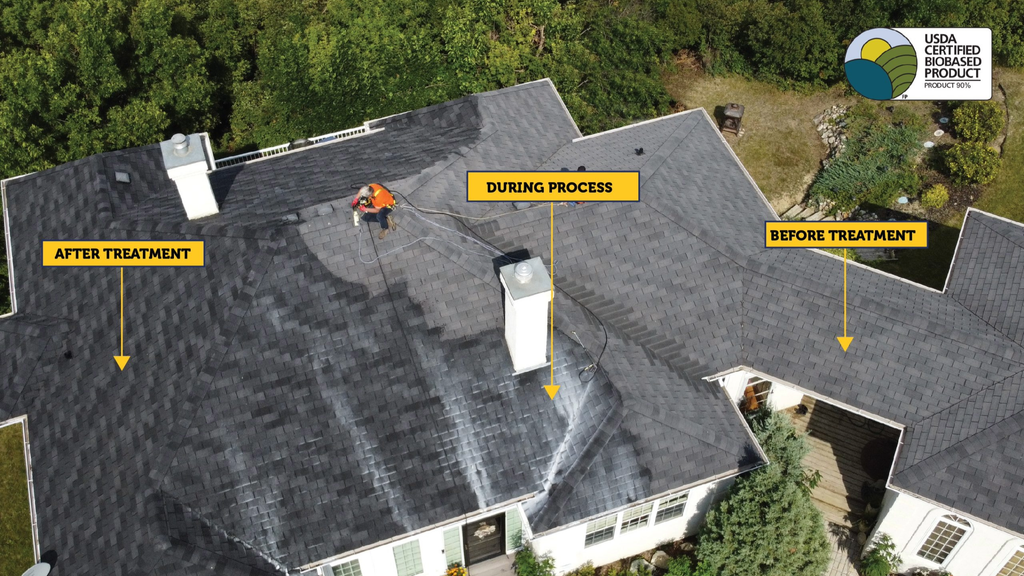
Asphalt shingles dry out. UV and heat cook the oils; tabs get brittle; granules let go. Soy methyl ester emulsion soaks into that weathered asphalt and restores flexibility. Granules hold. Water sheds. Hail leaves a smaller dent.
It is not a tinted sealer sitting on top. It is not a metal or tile treatment. And it is not a substitute for a roof that is already failed.
Lab results (PRI / Ohio State)
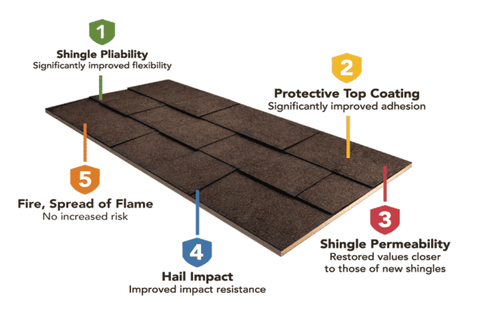
17-year three-tab shingles from central Ohio, treated at 1 gal / 100 ft², tested to ASTM and UL methods. Florida sun is harsher — we treat that as a ceiling, not a guarantee.
46%
fewer displaced granules
Adhesion 2.8 → 1.5 g lost (ASTM D4977)
60%
lower permeability
15 → 6; closer to a new shingle (ASTM E96)
24%
smaller hail depressions
UL 2218 impact: 0.20 → 0.15
Source: Vasco-Correa & Shah, The Ohio State University, summarizing PRI Construction Material Technologies testing. Pliability improved; flame spread did not increase. Authors note accelerated-aging follow-up is still needed.
Before and after
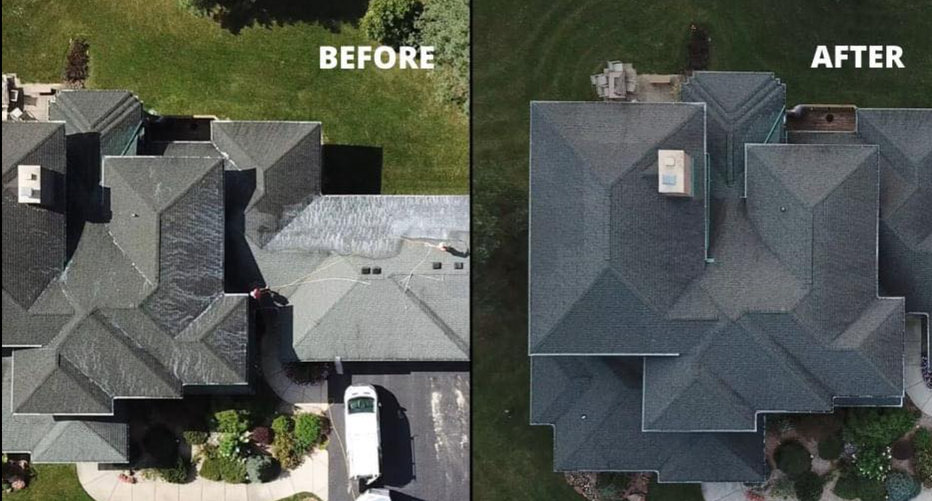
Manufacturer process photos — treated slope darkens as the emulsion soaks in. These are documentation shots, not a Wesley Chapel job. Your roof gets a drone survey first.
The money
Paper model: about $2,400 to treat a 2,000 ft² house, ~5 extra years of service per application. Same house as a tear-off is typically $9,500–$18,000 here.
Treat when it’s the right call. Replace when it isn’t. We say which.
The landfill
Treating one 2,000 ft² house avoids about 3.8 tons of waste and 1,500 kg CO₂e versus manufacturing and dumping a new asphalt roof (Ohio State / EPA WARM framing). 13.5 million tons of shingle waste a year in the U.S. Only 9% gets recycled.
Rejuvenation FAQ
What is roof rejuvenation?+
We spray a soy methyl ester emulsion (SMEE) that soaks into weathered asphalt and puts plasticizer back into the shingles. Dry, brittle tabs flex again. It is a restore, not a coating that sits on top.
Does it actually work?+
PRI Construction Material Technologies tested 17-year three-tab shingles treated at 1 gal/100 ft² (Ohio State summary). Results vs untreated: 46% fewer displaced granules, 60% lower permeability, 24% smaller hail depressions. Pliability improved. Flame spread did not get worse. Those roofs were from central Ohio — Florida UV is harder, so we inspect before we promise anything.
How much does it cost vs a new roof?+
The economic model in the paper used about $2,400 for a 2,000 ft² roof and ~5 extra years of service per application. A Tampa Bay tear-off on the same house is usually $9,500–$18,000. Restore when the roof still has life; replace when it doesn’t.
Is every asphalt roof a candidate?+
No. Widespread blow-off, rotten decking, failed flashing, or a roof at the end of its life needs replacement. Rejuvenation is for asphalt that is aging — dry, losing granules — not for a roof that is already leaking through the deck.
Does it work on metal or tile?+
No. SMEE is for asphalt shingles. We install metal and Spanish/clay tile as replacements when that’s the right system.
We also replace asphalt, install metal, and Spanish / clay tile when restore isn’t the move.
Not sure if it’s restore or replace?
That’s the inspection. We fly the roof and tell you straight.